
TL;DR

Get beauty and skincare favorites delivered free with Prime
- Fast, free delivery on millions of items
- Prime Video, Amazon Music and more included
- Member-only deals all year
A Glamour report, citing dermatologists, outlines how to use prescription tretinoin while limiting irritation: start with a low concentration a few nights a week and apply a pea-sized amount to clean, completely dry skin. Moisturizer can be layered before and after tretinoin, and the dermatologists advise daily sunscreen. Individual results and tolerance vary; the source says many people see results in eight to 12 weeks.
A Glamour UK report on how to apply prescription tretinoin says users should begin with a low concentration a few nights a week, using a pea-sized amount on clean, completely dry skin. Dermatologists quoted in the report also recommend moisturizer to help limit irritation and daily sunscreen, because tretinoin can increase sensitivity to sunlight.
Tretinoin is a prescription-only retinoid, a form of vitamin A, and is stronger than over-the-counter retinol, according to the report. Dermatologists cited by Glamour describe it as a treatment used for acne and other skin concerns, including dark spots, uneven texture and fine lines. Whether it is suitable for an individual, and which strength to use, depends on a clinician’s assessment and prescription.
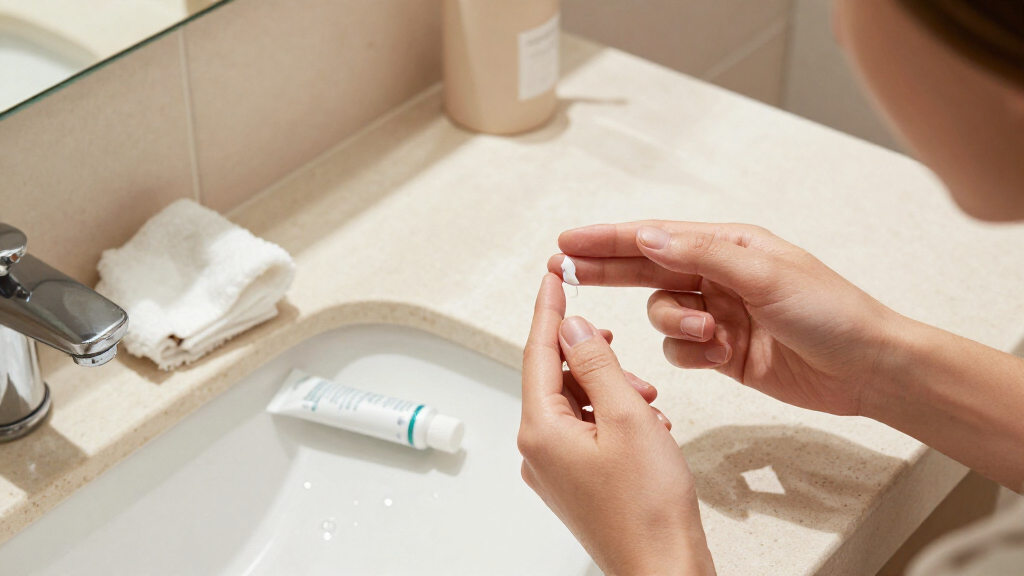
Aderonke Obayomi, a board-certified dermatologist and assistant professor at Mount Sinai, advises starting with the lowest concentration and applying it only a few nights a week at first. The skin should be cleansed and fully dry before application. Obayomi recommends no more than a pea-sized amount for the entire face, dotted around the face and gently spread until absorbed. The report cautions readers to avoid sensitive areas such as the corners of the eyes and lips.
To reduce dryness and irritation, Obayomi describes the “sandwich method”: apply a gentle moisturizer or petroleum jelly, then tretinoin, and then another layer of moisturizer. Allowing layers time to absorb can help keep them from mixing. The report suggests choosing a gentle moisturizer without active ingredients such as retinol or vitamin C, and names ceramides, peptides, squalane and hyaluronic acid as examples of barrier-friendly ingredients.
The dermatologists say irritation, flaking or an initial acne flare can occur as skin adjusts, particularly if treatment is introduced too quickly or at too high a concentration. Obayomi says many people see results in eight to 12 weeks, but that is a general estimate in the report, not a guarantee for any individual. She also recommends sunscreen of at least SPF 30 every morning; the article cites dermatologist Rachel Nazarian’s two-finger guide as one way to estimate an application amount.
Starting Tretinoin Without Overdoing It
The guidance matters because tretinoin is a prescription-strength treatment, not a routine cosmetic ingredient that the report recommends adding without clinical advice. Starting too often or using too much may worsen irritation, while a cautious schedule and moisturizer may make it easier to follow the prescribing clinician’s directions. The article does not establish that the suggested routine will prevent side effects.
Sun protection is another practical part of treatment: the report says tretinoin can make skin more sensitive to the sun and recommends daily broad-spectrum protection. Readers considering tretinoin should discuss their skin concerns, concentration and application schedule with the clinician prescribing it, and seek advice if irritation is severe or persistent.
As an affiliate, we earn on qualifying purchases.
Prescription Retinoid, Not Retinol
The report distinguishes tretinoin from retinol, an over-the-counter vitamin A derivative described as milder. It says tretinoin is prescription-only and is generally considered when a clinician identifies a skin concern for which prescription treatment may be appropriate. The supplied material does not provide prescribing criteria, compare specific strengths or offer evidence from a new clinical study; this is a service report summarizing dermatologist advice.
Dermatologist Shari Marchbein tells Glamour that retinoids affect collagen production and skin-cell turnover, and can help with acne and clogged pores. Those statements are expert explanations quoted by the publication, rather than findings from a study detailed in the article. The report’s practical recommendations focus on gradual use, a small amount, moisturizer and sun protection.
“A pea-size amount on the tip of your index finger is all that you need for the entire face.”
— Aderonke Obayomi, as quoted by Glamour
Individual Tolerance and Results Vary
The article does not specify the best concentration or schedule for a particular person, nor does it provide a clinical protocol for deciding when to increase use. Those choices should be guided by the prescribing clinician. It also does not quantify how often irritation or an initial acne flare occurs, how long either typically lasts, or which symptoms require stopping treatment.
The reported eight-to-12-week timeframe is a broad expectation attributed to Obayomi, not a promised result. The source does not detail the evidence or population behind that estimate, and results may differ. It also does not address every circumstance that could affect suitability, so readers should raise relevant health and medication questions with a healthcare professional.
Follow the Prescriber’s Instructions
For people who have been prescribed tretinoin, the immediate next step is to follow their clinician’s directions on concentration, frequency and application. The report’s general suggestions—starting gradually, using a pea-sized amount, moisturizing and applying sunscreen—are not a substitute for personalized instructions. Anyone who develops severe or persistent irritation should contact the prescribing clinician rather than trying to push through it or changing the schedule without advice.
People who have not been prescribed tretinoin should speak with a qualified healthcare professional before seeking or using it. The source provides no announcement of a policy or treatment change; it is a practical guide, and the report offers no new follow-up milestone beyond its general estimate that results may take eight to 12 weeks.
Key Questions
How much tretinoin should I apply?
The report quotes dermatologist Aderonke Obayomi recommending no more than a pea-sized amount for the whole face. Follow the amount and instructions on your prescription, and avoid sensitive areas such as the corners of the eyes and lips.
How often should I start using tretinoin?
Obayomi advises starting with the lowest concentration a few nights a week, then following the plan set by the prescribing clinician. The source does not give a schedule that suits everyone.
Can moisturizer be used with tretinoin?
Yes. The report describes applying gentle moisturizer before and after tretinoin as the sandwich method to help limit dryness and irritation. It recommends avoiding moisturizers with active ingredients such as retinol or vitamin C for this method.
Do I need sunscreen while using tretinoin?
The dermatologists quoted in the report recommend sunscreen every morning, with Obayomi specifying at least SPF 30. Ask your clinician for advice suited to your treatment and skin.
When might tretinoin results appear?
Obayomi says many people see results in eight to 12 weeks. The report presents this as a general estimate, not a guaranteed timeline; outcomes vary.
Source: rss
Fall Picks
fall essentials
As an affiliate, we earn on qualifying purchases.